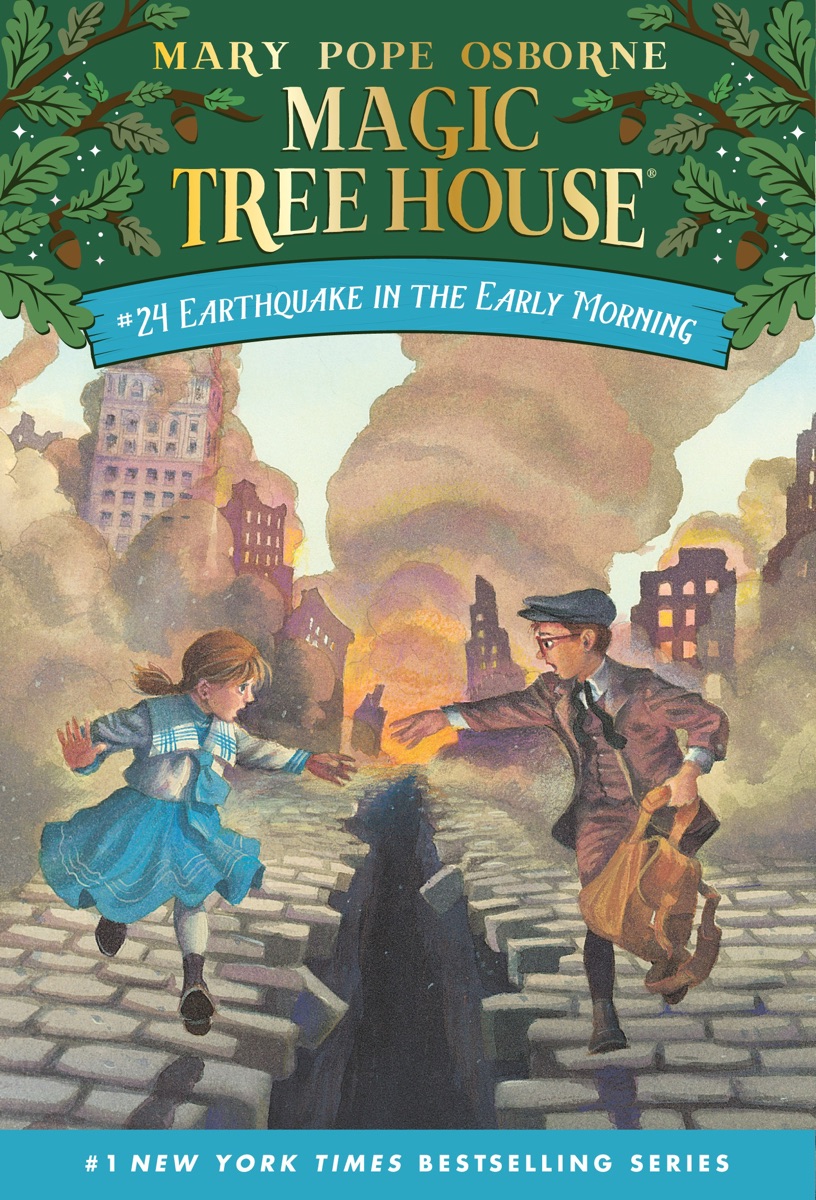
Earthquake in the Early Morning
by Mary Pope Osborne · Magic Tree House #24
The climactic fourth installment of the four-writings arc — Jack and Annie ride out the 1906 San Francisco earthquake, lend their boots to two barefoot brothers in exchange for a wooden hope poem, and finally meet the defeated king who has been waiting for the writings all along.
The story
Before dawn on a summer morning Jack and Annie return to the magic tree house in Frog Creek to find the fourth and final special kind of writing Morgan needs for her library — 'something to lend.' A book with the cover SAN FRANCISCO, CALIFORNIA, 1906 carries them back to a quiet golden cobblestone street at five A.M. on April 18, 1906. Eight minutes later the ground rumbles, church bells clang, the cobblestones roll like waves on the ocean, chimneys fall, gaslights topple — and a second harder shock hurls Jack to the ground while tall buildings sway and bricks rain. Annie falls into a crack in the street; Jack stacks bricks down to her so she can climb out. Through the dust they meet a wagon driver hauling bank money to the bay, a working female reporter named Betty and her photographer Fred, and a dust-covered librarian carrying ancient Bibles and gilt-bound treasures out of a beautiful building. Jack — for whom books are everything — runs to help. Only after they have finished loading the wagon does Jack open his research book and read the heartbreaking footnote: the rare books are being taken to the Pavilion, where they will all burn. They sprint after the wagon yelling Stop! Stop! but the driver waves them off and disappears over the hilltop. Annie pulls Jack toward a sobbing aunt and her two barefoot nephews on a crumbling stone wall. Jack and Annie immediately hand over their boots; when Andrew protests, Jack reframes it: 'Then we'll lend them to you.' Andrew offers a wooden plank his brother and he have been writing on with a chunk of coal — a poem about hope — and Annie suddenly realizes the brothers have just given them the special writing. In their sock feet Jack and Annie head down the hill past stretcher-carrying policemen, soldiers, a man pushing a piano, a woman with three little dogs in a bag, into a dynamite-alley sequence and a firestorm run that ends back at the tree house. Once home, Morgan le Fay finally appears in person, refuses the writings ('someone else needs them more'), and transports the children into her library at last — a huge shadowy room of leather and books and woodsmoke. In a chair in the corner sits a tired man with sad gray eyes who has lost all hope for his kingdom. Jack and Annie kneel and offer him the four writings one by one. 'And I am just an ordinary king,' he answers, and he stands up, wraps his cape around him, bows, and strides bravely out to speak to his knights. Back in Frog Creek the wind blows the research book open to a photograph of two dust-covered children holding the wooden hope poem — and Annie laughs that the brave children are them, and insists, on the rope ladder home, that the tired king was King Arthur.
Age verdict
Best for independent reading at 7-9; works as a parent read-aloud for thoughtful 6-year-olds and holds up for 10-year-olds who still enjoy the series, especially series readers finishing the four-writings arc.
Our take
A teacher-favored climactic Magic Tree House installment — cross-curricular 1906 earthquake fit, real-world historical anchors, reading-gateway credibility, and reluctant-reader rescue power outpace the kid-entertainment scores, which still benefit from one of the most vivid earthquake mental movies in the early series and the largest single payoff in the early run as the Tired King finally receives the four writings and stands up to walk back out to his knights.
What stands out
Each audience's top 3 dimensions. Out of 30 scored per book.
Kids love
- Ending satisfaction Exceptional
four whole books resolved in a single chapter. The Tired King stands up and walks out, Annie laughs 'Those brave children are us!' over Fred's photograph in the research book, and Jack on the rope ladder home thinks 'Maybe Annie was right. Maybe they really had helped King Arthur save Camelot. And maybe someday they would go back.' Sits below Fantastic Mr Fox's double-payoff feast because the resolution is more metaphorical and series-frame-dependent, but equals A Wolf Called Wander's full-circle satisfaction because both deliver catharsis earned through complete character transformation.
- Mental movie Exceptional
the gold quiet pre-quake city with painted wooden houses, gaslights, pink streaks behind tall buildings, then church bells clanging wildly, cobblestones rolling like waves on the ocean, chimneys falling, gaslights toppling, bricks raining. Osborne doubles this with the cracked-glasses librarian carrying ancient Bibles with sparkling gold covers in Ch.5, the man pushing a piano and woman with three little dogs in a bag in Ch.7, the dynamite blasts and firestorm in Ch.8, and the huge shadowy library smelling of leather, books and woodsmoke in Ch.9. Sal Murdocca's black-and-white interior drawings anchor every second spread. Sits at Lunch Lady level because the fully-illustrated format limits the relatability depth despite vivid prose, but the sensory precision equals or exceeds both benchmarks.
Parents love
- Real-world window Exceptional
13 A.M. timing, the Charles Crocker bank-money rescue, the Sutro Library books at the Mechanics' Pavilion (a real loss of about 200,000 rare books in a building that never burned), the mayor's failed dynamite firebreaks, Golden Gate Park as the refuge. The Facts About Earthquakes back matter delivers verified earth science and verified historical anchors in clean sentences. Confirms P6=9.
- Reading gateway Exceptional
short illustrated chapters of about 6-7 pages each, controlled vocabulary at roughly Lexile 550L, familiar Jack-and-Annie duo, an obligatory research book and back-matter Facts section. This title has eighty published lesson plans, recurring Scholastic Book Fair presence, and active rotation in the Magic Tree House Classroom Adventures Program. Confirms P7=9.
Teachers love
- Classroom versatility Exceptional
a 1906 San Francisco earthquake unit, a California history unit, a natural disasters unit, or a plate tectonics/earth science unit. Decades of teacher-built Magic Tree House lesson plans make a multi-day unit around this single title trivial to assemble. The Facts About Earthquakes back matter is itself a usable in-class read-aloud text for a single earth-science lesson. Confirms T2=9.
- Cross-curricular value Exceptional
Comparable to benchmark T4=9 — One title bridges history (1906 San Francisco earthquake, the Sutro Library, Charles Crocker, the Mechanics' Pavilion, Golden Gate Park), earth science (plate tectonics, the San Andreas Fault, seismology), social studies (community response to disaster, civic mutual aid, rebuilding), language arts (writing a poem about hope, the lending verb), and emergency preparedness (modern earthquake building codes, household survival kits). The Facts About Earthquakes back matter is a ready-made ELA-to-earth-science bridge. Confirms T4=9.
✓ Perfect for
- • 7-9 year olds ready for their first real encounter with the 1906 San Francisco earthquake as lived experience
- • Kids who already know and like the Magic Tree House series, especially anyone who has read Books #21-23 in the four-writings arc
- • Reluctant second- to fourth-grade readers who want serious natural-disaster content at a comfortable reading level
- • Classroom 1906 earthquake, California history, natural disasters, or plate tectonics units
- • Families who want a gentle way to open age-appropriate conversations about losing everything you have, helping when you cannot fix things, and the difference between giving and lending
Not ideal for
Very sensitive young readers who want a purely fun Magic Tree House adventure without on-page natural disaster — this installment renders the actual 5:13 A.M. shocks, falling chimneys, swaying buildings, Annie falling into a crack in the street, an approaching firestorm, and a dynamite-firebreak alley sequence, and some children under seven will want a parent nearby.
At a glance
- Pages
- 80
- Chapters
- 10
- Words
- 6k
- Lexile
- 550L
- Difficulty
- Easy
- POV
- Third Person Limited
- Illustration
- Moderate
- Published
- 2001
- Publisher
- Random House Books for Young Readers
- Illustrator
- Sal Murdocca
- ISBN
- 9784040664798
Mood & style
You'll know it worked when…
Children who finish this one and immediately ask for the next book in the series — Magic Tree House #25 begins the formal Merlin Missions arc that the closing scene of this book teases — are ready for the longer Merlin Missions installments in general, and their reaction to the unnamed Tired King reveal is a strong signal of how much they have been tracking the whole arc.
If your kid loved "Earthquake in the Early Morning"
Matched across 30 dimensions — interest hooks, character appeal, tone, pacing, emotional core. Not by what other people bought. By what fits the same reader profile.
I Survived the Sinking of the Titanic, 1912
by Lauren Tarshis
Same genre (historical). Same pacing (steady clip)

Flashback Four #1: The Lincoln Project
by Dan Gutman
Same genre (historical). Same pacing (steady clip)

Refugee
by Alan Gratz
Same genre (historical). Same tension source (survival)

Little House on the Prairie
by Laura Ingalls Wilder
Same genre (historical). Same emotional weight (moderate)
The Underground Abductor
by Nathan Hale
Same genre (historical). Same pacing (steady clip)
Ground Zero
by Alan Gratz
Same genre (historical). Same tension source (survival)
Want more picks like this?
Get 5 hand-picked book reviews for your child's age — one email a month.