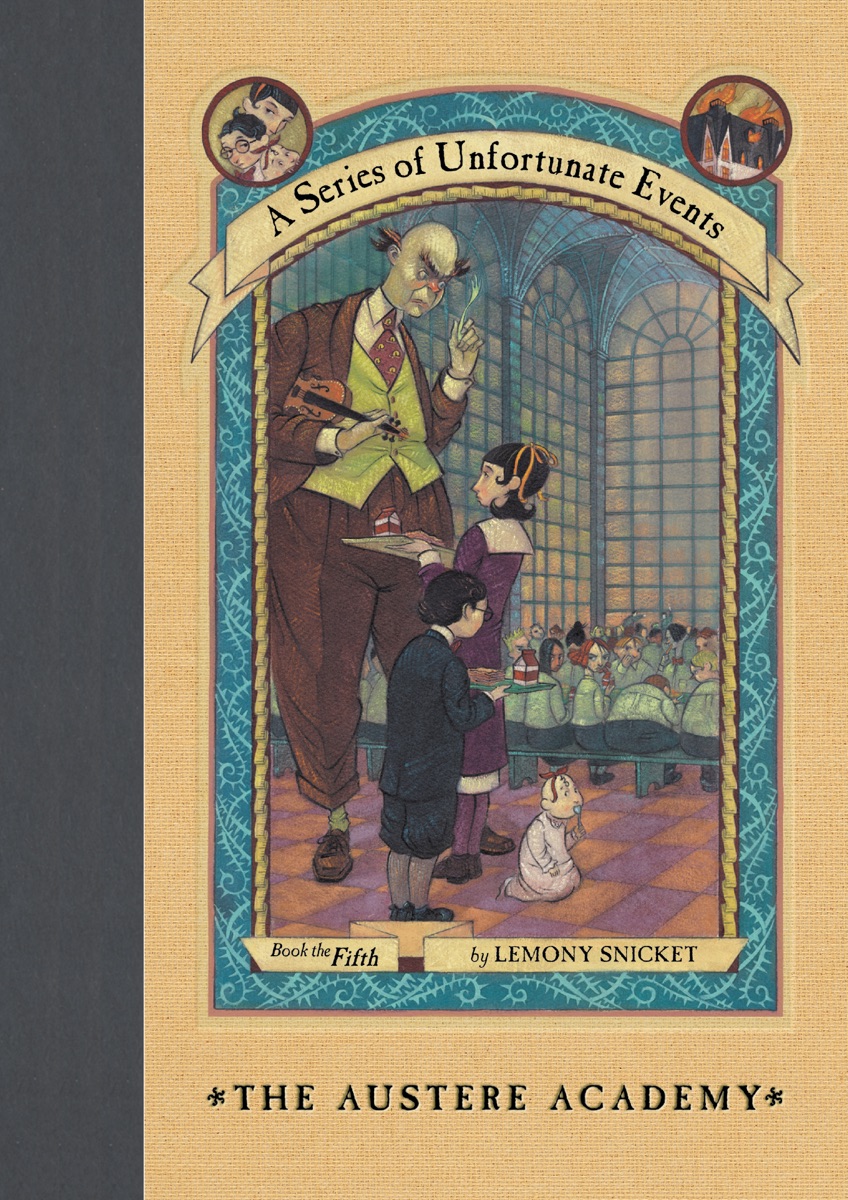
The Austere Academy
by Lemony Snicket · A Series of Unfortunate Events #5
Dark humor meets genuine heartbreak as the Baudelaire orphans face their most personal loss yet at a boarding school that refuses to protect them.
The story
Sent to Prufrock Preparatory School, the Baudelaire orphans encounter a vice principal who values his own terrible violin playing over student safety, teachers who teach nothing useful, and a suspicious new gym coach. They find unexpected allies in fellow orphans the Quagmire triplets, but a mounting threat puts everything — and everyone — at risk.
Age verdict
Best for ages 9-11. The dark humor and institutional satire reward readers old enough to recognize irony, while the vocabulary instruction and accessible plot structure keep it approachable. Younger readers (8) can enjoy it with adult support; older readers (12-13) still find the literary craft engaging.
Our take
Literarily strong series installment with distinctive voice and vocabulary instruction that impresses adults more than it thrills kids — the deliberately unsatisfying ending and formula predictability limit kid scores while the sophisticated craft and mentor text quality elevate teacher and parent ratings.
What stands out
Each audience's top 3 dimensions. Out of 30 scored per book.
Kids love
- Character voice Strong
Comparable to The Golem's Eye , escalated through triangulation with City Spies — Snicket's narrator voice and ensemble character voices (Sunny's coded speech, Nero's pomposity, Isadora's couplets, Carmelita's repetitions) create multi-layered distinctiveness that exceeds the anchor's three narrators. Sits above (8) because every speaker is immediately identifiable without tags, and the voice carries emotional resonance ('world-weary, genuinely funny'). The sophistication of the literary narrator plus the ensemble strength justifies tier 3 escalation.
- First-chapter grab Strong
Comparable to Lunch Lady and the Cyborg Substitute — Opens in a kid-grounded space (the cafeteria) with immediate stakes. Snicket's reverse-psychology hook ('you should stop reading') is equally irresistible to a 9-12 reader as the cafeteria-setting opening, and the gravestone architecture creates visual dread immediately. Sits at (7) rather than (8) because while the intellectual hook rewards sophisticated readers, the formula is established by Book 5, so the element of surprise is lower than a first-installment entry.
Parents love
- Vocabulary builder Exceptional
Tier 3 — Comparable to Charlotte's Web , triangulated with A Deadly Education — Snicket's definitional vocabulary technique is among the most effective in all children's literature, building vocabulary entertainment-first. Words like 'adversity,' 'austere,' 'luminous' are explicitly defined within narrative flow. Sits at (9) rather than (10) because the technique, while masterful, is signature-Snicket repetitive across the series, whereas Charlotte's Web vocabulary instruction feels singular and earned within a self-contained narrative.
- Writing quality Strong
Comparable to A Tale Dark and Grimm — Snicket's prose is syntactically complex, tonally controlled, and rhythmically deliberate. Opening paragraphs demonstrate sophisticated hooking; narrator's digressions model essay-like reasoning; ironic distance between statement and reality rewards close reading. Score stays 8 — masterful but not experimental enough for (9).
Teachers love
- Mentor text quality Strong
Comparable to City of Bones , recalibrated — Snicket's definitional technique is a widely-taught mentor text for vocabulary-in-narrative instruction. Opening paragraphs model hooking; narrator's direct address teaches engagement; dramatic irony teaches craft. Sits at (8) rather than (10) because the technique, while teachable, is signature-specific rather than broadly generalizable.
- Read-aloud power Strong
narrator's asides, definitions, rhetorical questions create natural pause points. A teacher can voice Nero's pomposity, Carmelita's cruelty, Sunny's coded responses distinctly. Chapter endings hook listeners. Sits at (7) — strong but not best-in-class because the dark tone and series context limit universal read-aloud applicability.
✓ Perfect for
- • Kids who love dark humor and feeling smarter than the adults in the story
- • Readers who enjoyed the first four books and are ready for the series to deepen its mystery
- • Children age 9-12 who reject sweet or earnest books in favor of something edgy and sophisticated
- • Vocabulary enthusiasts who enjoy learning new words through entertaining context
Not ideal for
Children who need happy endings or find institutional cruelty distressing. Sensitive readers may struggle with the deliberately unsatisfying conclusion and the loss of beloved characters. Not a standalone entry point — requires familiarity with the series.
⚠ Heads up
At a glance
- Pages
- 221
- Chapters
- 10
- Words
- 30k
- Lexile
- 1120L
- Difficulty
- Challenging
- POV
- Third Person Omniscient
- Illustration
- Sparse
- Published
- 2000
- Publisher
- HarperCollins
- Illustrator
- Brett Helquist
- ISBN
- 9780064408639
Mood & style
You'll know it worked when…
Kids who laugh at the narrator's warnings, immediately ask for Book 6, or start using Snicket's vocabulary words in conversation have found their series.
If your kid loved "The Austere Academy"
Matched across 30 dimensions — interest hooks, character appeal, tone, pacing, emotional core. Not by what other people bought. By what fits the same reader profile.
Absolutely Truly
by Heather Vogel Frederick
Same genre (mystery). Same pacing (steady clip)

The Name of This Book Is Secret
by Pseudonymous Bosch
Same genre (mystery). Same emotional weight (moderate)

The Case of the Missing Marquess
by Nancy Springer
Same genre (mystery). Same pacing (steady clip)
The Blackthorn Key
by Kevin Sands
Same genre (mystery). Same emotional weight (moderate)

The House on the Cliff
by Franklin W. Dixon
Same genre (mystery). Same pacing (steady clip)

Chasing Vermeer
by Blue Balliett
Same genre (mystery). Same pacing (steady clip)
Want more picks like this?
Get 5 hand-picked book reviews for your child's age — one email a month.