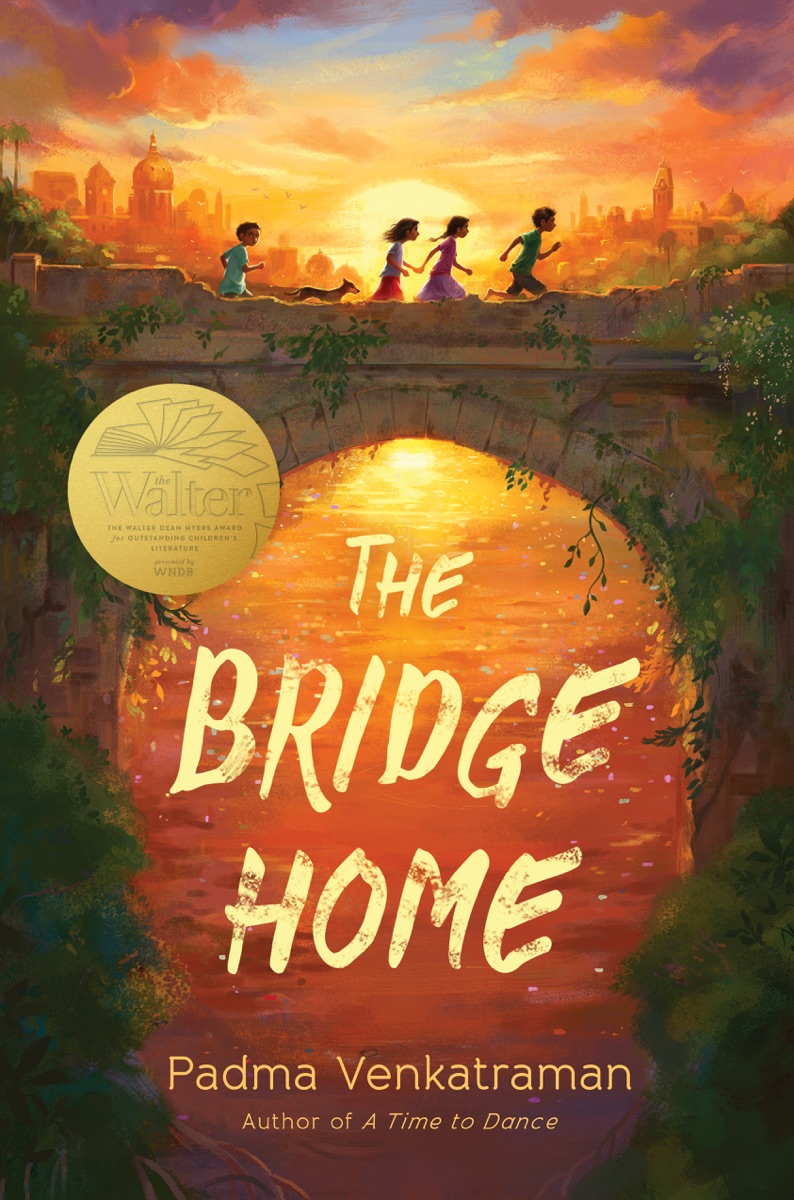
The Bridge Home
by Padma Venkatraman
A quietly devastating Walter-winning novel about four homeless children who build a family on a Chennai bridge.
The story
Eleven-year-old Viji and her older sister Rukku flee their abusive father and find shelter on an abandoned bridge, where they join two homeless boys and a stray dog in a chosen family. Padma Venkatraman, drawing on interviews with real street children in Chennai, renders their resourcefulness, joy, and eventual heartbreak in prose that reads as both urgent and tender. A Walter Dean Myers Award and Golden Kite winner; one of the strongest upper-MG social-justice novels in print.
Age verdict
Best for 10-13. Capable 9-year-olds with adult support; teens will also gain.
Our take
Literary heavyweight: parent/teacher strong, kid moderate — a Walter-winning realist novel parents give kids, not a mass-market hit.
What stands out
Each audience's top 3 dimensions. Out of 30 scored per book.
Kids love
- Heart-punch Exceptional
Grief is not backstory but the book's emotional engine — present on every page through the epistolary frame, building to Ch 36 Rukku's one-sentence death ('your own body was as stiff as a wooden doll's'), Ch 32 selling Kutti as moral cost, Ch 43 Appa's carved replacement Marapachi, and Ch 44's sustained image-inventory elegy. Stands shoulder to shoulder with Tristan Strong Punches a Hole in the Sky (10, grief as engine on every page) while trading fantasy displacement for realist intimacy.
- First-chapter grab Strong
Opening line 'Talking to you was always easy, Rukku. But writing's hard.' delivers voice, relationship, and loss in thirteen words — a voice-driven hook stronger than All the Broken Pieces (7, verse poem mystery) and in league with the emotional intensity of Lunch Lady (8, kid-grounded) while trading physical action for emotional immediacy. By Ch 2 Appa breaks Amma's arm on Viji's eleventh birthday; hook earns its grip without exposition.
Parents love
- Writing quality Exceptional
Winner of the SCBWI Golden Kite Award for writing craft. Ch 11's orange paragraph is a masterclass in small-moment prose; Ch 32's six-sentence internal-debate rhythm ('I didn't want to. I had no right to. I couldn't do it. / I could. / I had to.') models internal-conflict structure; Ch 36's one-line death ('your own body was as stiff as a wooden doll's') models restraint. Comparable to Interrupting Chicken (8, mastery of register at sentence level) and approaching Illuminae (9) at sentence-level mastery within MG realism.
- Stereotype-breaker Exceptional
A disabled older sister (Rukku) is rendered as the book's moral and spiritual center — not burden, not symbol, but specific: she rolls vadais better than her sister (Ch 6), runs her own bead-necklace business (Ch 17), saves Kutti during Divali (Ch 28), mourns the worms in the rain (Ch 29). Ch 14: 'even I expected too little of you.' Pairs with representation of Tamil/Dalit street children, Muslim-Christian-Hindu religious pluralism (Ch 38), and three distinct child-gender representations. Matches Gathering Blue (9, disabled protagonist never framed as overcome); Walter Dean Myers Award winner.
Teachers love
- Cross-curricular value Exceptional
Dense cross-curricular yield — geography (Chennai, Tamil Nadu, 2004 Indian Ocean tsunami Ch 19), world religions (Hindu, Christian, Muslim pluralism Ch 25/28/38), biology and public health (dengue fever, monsoon disease vectors Ch 35), social studies (child labor, caste, homelessness, migration Ch 14/30), language (Tamil loanwords throughout), disability studies (Ch 40 Lalitha's school). Gate floor T4=6; comparable to A Wolf Called Wander (10, biology/geography/ecology) at 9 because the curricular spread is nearly identical but realist rather than naturalist.
- Empathy & self-awareness Exceptional
Systematically builds empathy across multiple unfamiliar perspectives — disability (Ch 14 'I expected too little of you'), child trafficking (Ch 30 Muthu's sweatshop backstory makes abstract statistics personal), enemies reframed as casualties (Ch 31 Sridar's death), and even abuse victims toward abusers (Ch 43 pity for Appa alongside self-protective refusal). Comparable to Amal Unbound (8, perspectives across cultural, economic, gender divides) pushed to 9 by breadth of empathy axes and by Walter Award recognition for this precise capacity.
✓ Perfect for
- • Readers who loved Bridge to Terabithia, A Long Walk to Water, or Amal Unbound
- • Classrooms studying global citizenship, disability representation, or social justice
- • Kids with siblings (especially those with disabled or neurodivergent siblings)
- • Families looking for a conversation-starter novel about poverty, faith, or forgiveness
- • Confident grade 5-8 readers ready for emotional weight
Not ideal for
Younger or emotionally sensitive readers not ready for child death, domestic abuse, or a pet being sold; readers who want escapist fun or a rescued-pet ending.
⚠ Heads up
At a glance
- Pages
- 208
- Chapters
- 44
- Words
- 45k
- Lexile
- 680L
- Difficulty
- Moderate
- POV
- Second Person
- Illustration
- None
- Published
- 2019
Mood & style
You'll know it worked when…
high
If your kid loved "The Bridge Home"
Matched across 30 dimensions — interest hooks, character appeal, tone, pacing, emotional core. Not by what other people bought. By what fits the same reader profile.
The Remarkable Journey of Coyote Sunrise
by Dan Gemeinhart
Same genre (realistic fiction). Both bittersweet in tone

Coo
by Kaela Noel
Same genre (realistic fiction). Both bittersweet in tone

King and the Dragonflies
by Kacen Callender
Same genre (realistic fiction). Both bittersweet in tone
Crenshaw
by Katherine Applegate
Same genre (realistic fiction). Both bittersweet in tone
Harbor Me
by Jacqueline Woodson
Same genre (realistic fiction). Both bittersweet in tone

The Season of Styx Malone
by Kekla Magoon
Same genre (realistic fiction). Both bittersweet in tone
Want more picks like this?
Get 5 hand-picked book reviews for your child's age — one email a month.