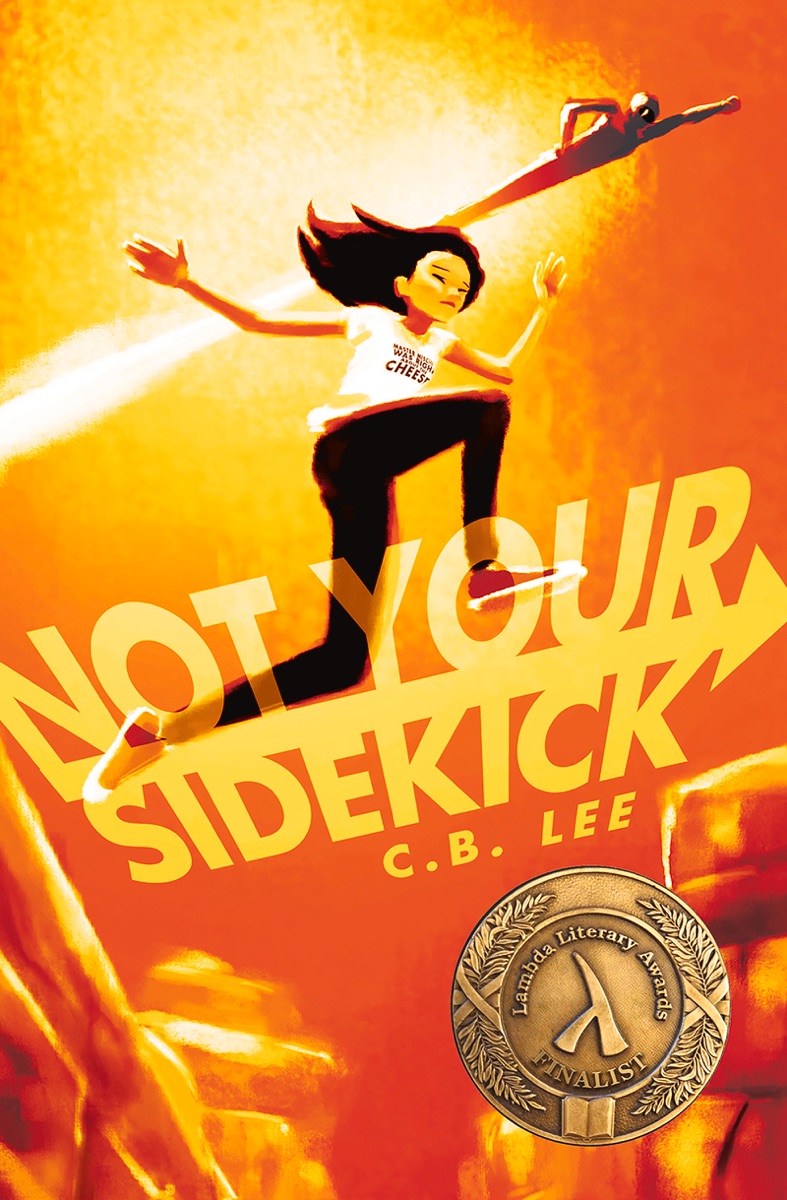
Not Your Sidekick
by C.B. Lee · Sidekick Squad #1
A romantic superhero adventure about a late-blooming Vietnamese-Chinese American girl whose power turns out to be the one the League never counted on.
The story
In a near-future North America rebuilt after a solar disaster, seventeen-year-old Jess Tran is the only one in her family without a superpower. A boring-sounding internship, a crush on a classmate named Abby, and a mysterious hooded figure tinkering with a mecha suit in the basement lead her into a story about what the heroes and villains on the news are really doing — and into a refusal that gives the book its name. First in a four-book series; standalone-readable with a clear hook into Book 2.
Age verdict
Best for readers 12 and up. Advanced 10-11 year olds may enjoy it, but parents should preview the sleepover scene and political framing. Reads comfortably through high school.
Our take
Entertainment-leaning upper-middle-grade bridge with strong representation and dual-audience craft; classroom reach is limited by length and LGBTQ content.
What stands out
Each audience's top 3 dimensions. Out of 30 scored per book.
Kids love
- New world unlocked Strong
The NAC rebuilt after the X29 solar flare — meta-humans, DEDs, MonRobots, hovertrains, the Collective's paired-track system, the Heroes' League of Heroes vs Villain's Guild — is a fully realized near-future introduced through context rather than infodump, rich enough to sustain three more novels. Opens the 9-12 reader to real-world questions about media control, government disaster response, and post-climate infrastructure. Stronger than Earthquake in the Early Morning (8, first encounter with 1906 SF) and Gathering Blue (7); short of Artemis Fowl (10, a whole fairy civilization) and Golem's Eye (9, seven planes of existence).
- First-chapter grab Strong
Chapter 1 opens with Jess at Red Rock Canyon talking herself into a leap she cannot fly off of, on her seventeenth birthday — a physical, comic, emotionally grounded hook that also seeds the whole world (X29 flare, meta-humans, her hero family) in her interior monologue. Stronger than All the Broken Pieces (7, verse-mystery opening) for the 9-12 reader because the peril is low-stakes and the voice is immediate; lighter than Lunch Lady (8, cafeteria-to-cyborg joke) or Artemis Fowl (10, twelve-year-old running a criminal operation). Solid mid-high hook rather than propulsive.
Parents love
- Stereotype-breaker Exceptional
One of the book's signature strengths and the reason it was a Lambda Literary Award finalist: the Vietnamese-Chinese American bisexual protagonist is ambient rather than explanatory (no coming-out scene, no othering frame), the Black trans shapeshifter best friend Bells has transness woven into his powers rather than treated as a separate theme, and queer identity is presented as the Collective's baseline rather than a deviation. For a 2016 YA this is the level of Gathering Blue (9, disabled protagonist never framed as overcoming) and approaches Legendborn (10, stereotype breaks at system level).
- Parent-child conversation starter Strong
Multiple conversation axes all active: Orion's 'people should be able to feel good that there are heroes' speech (Ch 17) opens news/narrative control; Abby's volleyball-as-practice monologue (Ch 18, '99% of anything is a person working really, really hard') opens effort vs talent; Jess's bisexuality, Bells's transness, and the Collective's forced pairings open identity and family values. On par with Knuffle Bunny (8, adults failing to understand) and approaching Blended (9, every thread invites family conversation).
Teachers love
- Discussion fuel Strong
Every major thread generates honest student disagreement: Was Jess right to publish the datachip footage? Is Orion wrong, or wrong-ish, about the public's 'right to hope'? Is Abby without her powers the same person? Is Bells a hero for defecting or a fool for burning his cover? The Ch 17 Jess-Orion exchange is a ready-made Socratic-seminar prompt. At Breakout (10) level for multi-thread debate territory? No — below that, but clearly at Fantastic Mr Fox (7, theft question splits classrooms) and approaching Sunny Rolls the Dice (9, peer-pressure and authenticity questions).
- Writing prompt potential Strong
Uncommonly direct: Ms. Rhinehart's assignment IS a classroom writing prompt transposable to any grade (two students co-write a short story whose protagonists mirror themselves), and her closing note 'What happens after they defeat the evil Schuester?' is a continuation prompt on the page. Above Illuminae (6, primarily models prompts in one or two types) and Tale Dark and Grimm (7, 'retell from villain's perspective'); approaching Blended (8, identity writing) but not Deadly Education (10, voice-establishment exercises embedded chapter by chapter).
✓ Perfect for
- • readers ready to step from middle-grade adventure into upper-YA with a queer first-love story
- • fans of superhero fiction who want character work more than cape-counting
- • teens looking for ambient, non-othering representation of Asian American, queer, and trans identity
- • kids who like a mystery they can solve before the protagonist does
Not ideal for
Younger 9-10 year old readers who are not yet ready for on-page sensual kissing, restraint-violence, and themes of government deception and human experimentation.
⚠ Heads up
At a glance
- Pages
- 288
- Chapters
- 18
- Words
- 82k
- Difficulty
- Moderate
- POV
- Third Person Limited
- Illustration
- None
- Published
- 2016
Mood & style
You'll know it worked when…
Strong — short chapters, braided romance and mystery, and a title line that lands near the end keep most readers turning pages. Many finish in a weekend.
If your kid loved "Not Your Sidekick"
Matched across 30 dimensions — interest hooks, character appeal, tone, pacing, emotional core. Not by what other people bought. By what fits the same reader profile.
Cinder
by Marissa Meyer
Same genre (sci fi). Both hopeful in tone

The Cardboard Kingdom
by Chad Sell
Both hopeful in tone. Same pacing (measured)

The People of Sparks
by Jeanne DuPrau
Same genre (sci fi). Both hopeful in tone

Full Cicada Moon
by Marilyn Hilton
Both hopeful in tone. Same pacing (measured)

Criss Cross
by Lynne Rae Perkins
Same pacing (measured). Same emotional weight (moderate)
Each Tiny Spark
by Pablo Cartaya
Both hopeful in tone. Same pacing (measured)
Want more picks like this?
Get 5 hand-picked book reviews for your child's age — one email a month.