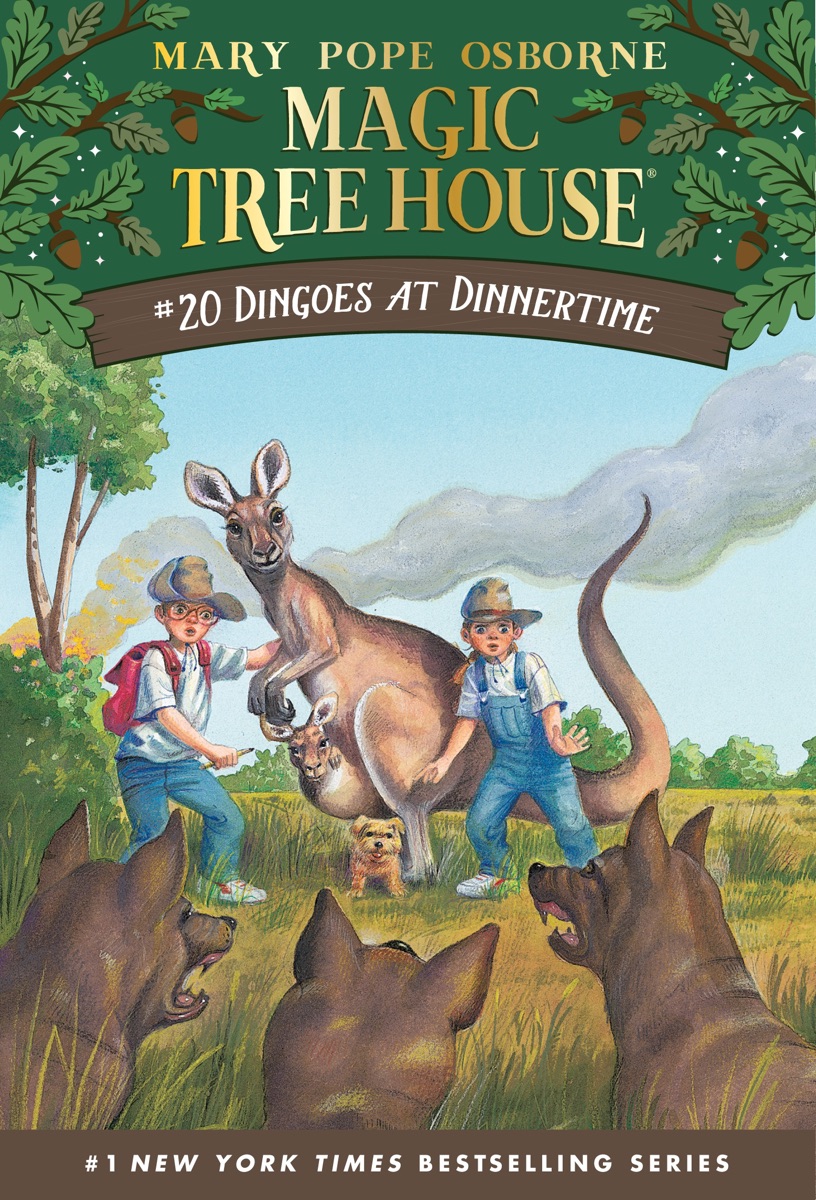
Dingoes at Dinnertime
by Mary Pope Osborne · Magic Tree House #20
Jack and Annie hop to the Australian outback in search of a kangaroo's gift, dodge wild dingoes and a wildfire, and stumble onto an Aborigine cave painting that answers a child's gesture with rain.
The story
The twentieth Magic Tree House adventure carries Jack and Annie to a drought-stricken eucalyptus forest in Australia for the final gift in their four-gift quest to free Teddy the dog from a spell. They meet a sleepy koala, a hopping mother kangaroo with a joey in her pouch, and a cackling kookaburra before wild dingoes burst from the bushes and a fast-moving wildfire forces a real rescue. Hidden inside a cave they find a glowing Rainbow Serpent painting and a row of handprints, and when the children touch the prints the Aborigine cosmology answers them with rain. Mary Pope Osborne braids three threads into one short book — an early-elementary nature unit on the Australian outback and its marsupials, a wildfire-rescue adventure with real but bounded peril, and a respectful introduction to Aborigine Dreamtime cosmology — and closes the long-running 'who is Teddy?' arc that began in book seventeen with a quietly satisfying transformation in the tree house.
Age verdict
Best for ages 6-8; works as a read-aloud from age 5 and as an independent read up to about age 9 before the controlled vocabulary feels limiting.
Our take
growth-leaning early-chapter gateway
What stands out
Each audience's top 3 dimensions. Out of 30 scored per book.
Kids love
- Middle momentum Strong
Off the Hook — chapters 2-5 stack dingo encounter, joey rescue, wildfire, and cave magic in close succession. Sits at anchor level — fresh setpiece every chapter sustains forward pull. Tier 2: displacement-pacing engine confirmed; no Tier 3 needed.
- New world unlocked Strong
Comparable to Earthquake in the Early Morning — in 80 pages delivers Australian outback ecology (drought, eucalyptus, marsupials, dingoes, kookaburra, wildfire) and respectful introduction to Aborigine Dreamtime and Rainbow Serpent. Sits at anchor level — first encounter with real continent and living Indigenous tradition; book IS the window. Tier 2: anchor match confirmed; no Tier 3 needed.
Parents love
- Real-world window Strong
Comparable to Earthquake in the Early Morning — book is essentially window onto real continent — Australian geography, marsupial biology, drought ecology, wildfire dynamics, Aborigine Dreamtime cosmology rendered with factual care plus 'More Facts For You and Jack' afterword. Sits at anchor level — first encounter with real place and Indigenous tradition. Tier 2: anchor match confirmed; no Tier 3 needed.
- Reading gateway Strong
Comparable to A Bear Called Paddington — Magic Tree House is one of most reliable bridges from picture books into independent chapter reading; this installment's wildfire-rescue stakes, animal peril, and magical cave-and-rain payoff unusually propulsive. Sits at anchor level — one of series' strongest early-chapter gateways; gateway effectiveness is confirmed. Tier 2: anchor match confirmed; no Tier 3 needed.
Teachers love
- Cross-curricular value Strong
Comparable to A Wolf Called Wander — Australian geography, marsupial biology, drought ecology, fire safety, and Aborigine art and cosmology connect naturally to science, social studies, and art curricula in single short text. Sits at anchor level — teacher can build whole interdisciplinary week; cross-curricular density approaches Wander's sophistication. Tier 3: mandatory for T4; confirms 8 is justified by four distinct curriculum threads.
- Read-aloud power Strong
Comparable to Gathering Blue , triangulated with The Golem's Eye — short sentences, dialogue-heavy beats, repeated lyrical refrains make natural lower-elementary read-aloud; dark-cave passage with glowing snake is teacher's showpiece for sensory storytelling. Sits at anchor level — natural read-aloud rhythm and pacing; lyrical refrains support performance without Gathering Blue's sophisticated emotional palette. Tier 3: mandatory for T1; confirms 7 is correct despite lower literary complexity than anchor.
✓ Perfect for
- • First and second graders ready to commit to a chapter book
- • Kids who love animals, especially Australian wildlife
- • Reluctant readers who need a short, hooky, action-driven entry point
- • Families using the series as an at-home geography or biome curriculum
- • Read-aloud at bedtime for kindergarten and early elementary
Not ideal for
Older middle-grade readers (ages 9 and up) who have outgrown the series's gentle voice, kids who want laugh-out-loud humor or sustained suspense, and readers brand-new to the series who want the cross-installment Teddy mystery to land — those readers should start at book seventeen.
⚠ Heads up
At a glance
- Pages
- 80
- Chapters
- 10
- Words
- 8k
- Difficulty
- Easy
- POV
- Third Person Limited
- Illustration
- Moderate
- Published
- 2000
- Publisher
- Random House Children's Books
- Illustrator
- Sal Murdocca
- ISBN
- 9788955857115
Mood & style
You'll know it worked when…
A child who finishes this in two or three sittings is squarely inside the Magic Tree House sweet spot and is ready for the rest of the series and other early-chapter staples.
If your kid loved "Dingoes at Dinnertime"
Matched across 30 dimensions — interest hooks, character appeal, tone, pacing, emotional core. Not by what other people bought. By what fits the same reader profile.
The Truth About Bats
by Eva Moore
Same genre (adventure). Both adventurous in tone
The Wild Whale Watch
by Eva Moore
Same genre (adventure). Both adventurous in tone
Dinosaurs Before Dark Graphic Novel
by Mary Pope Osborne (adapted by Jenny Laird)
Same genre (adventure). Both adventurous in tone

The Hundred and One Dalmatians
by Dodie Smith
Same genre (adventure). Both adventurous in tone
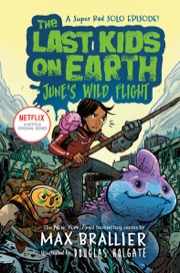
The Last Kids on Earth: June's Wild Flight
by Max Brallier
Same genre (adventure). Both adventurous in tone

Boris on the Move
by Andrew Joyner
adventure as secondary genre. Same pacing (steady clip)
Want more picks like this?
Get 5 hand-picked book reviews for your child's age — one email a month.