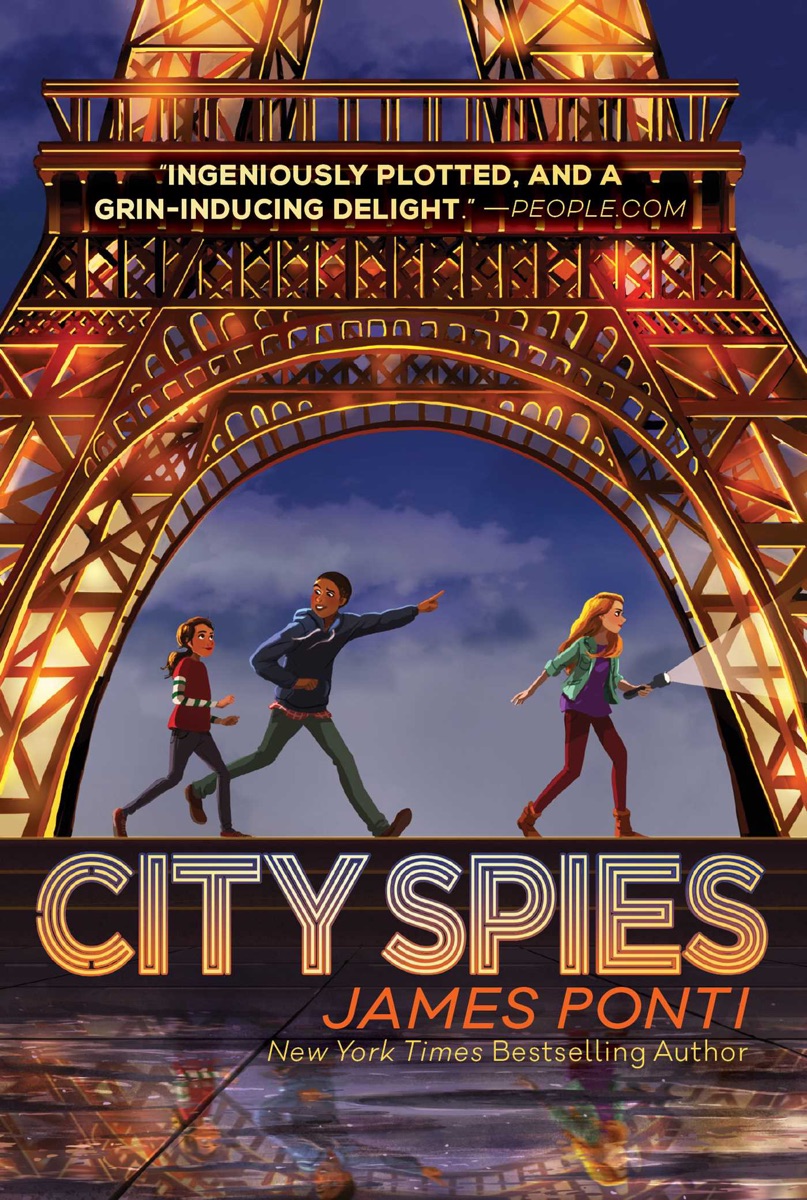
City Spies
by James Ponti · City Spies #1
A diverse team of kid spies on their first MI6 mission — fast-paced, heartfelt, and genuinely exciting.
The story
When a twelve-year-old Latina hacker faces prison for breaking into the foster care system, a mysterious British intelligence agent offers her an alternative: join a team of five extraordinary kids from around the world who work as MI6 operatives. Based at a remote Scottish facility, the team must learn to trust each other while preparing for their first real mission in a European capital city. Equal parts spy thriller and found-family story.
Age verdict
Best for ages 9-12. The spy premise and action pacing hook readers at 9, while the moral complexity and foster care themes resonate most with 10-12 year olds. Eight-year-olds with reading stamina can handle it; thirteen-year-olds will enjoy the ride but may find it light.
Our take
Entertainment-forward adventure with strong classroom utility — kids love the spy premise and pacing, teachers value the reluctant-reader appeal and cross-curricular connections, parents appreciate the diversity and real-world knowledge but note modest literary depth.
What stands out
Each audience's top 3 dimensions. Out of 30 scored per book.
Kids love
- Character voice Exceptional
Comparable to Knuffle Bunny , triangulated with Children of Blood and Bone — Knuffle establishes three distinct voices (Trixie urgency, Knuffle silence, mother clarity); City Spies sustains five across 378 pages (Sara sarcasm, Sydney Australian ease, Paris survivor restraint, Kat precision, Rio playfulness). Zélie and Amari demonstrate percussive emotional voice; City Spies voices equally distinct and sustained. Sits at K3=9: five sustained voices exceed Knuffle model and match highest-tier voice anchors.
- First-chapter grab Strong
Comparable to Lunch Lady and the Cyborg Substitute — Both establish immediate stakes and distinctive character voice within the opening chapter. Sara's detention-center crisis (personal stakes, immediate tension) matches Lunch Lady's cafeteria hook in emotional immediacy. Sits at same level.
Parents love
- Reading gateway Strong
Comparable to City Spies itself as benchmark anchor — City Spies is listed at P7=6 in benchmark decision cards as "short chapters, immediate stakes, relatable protagonist." Book demonstrates all gateway indicators: short chapters (averaging 1,000 words), spy premise appealing broadly, diverse cast offering multiple identification points, accessible vocabulary, action-driven pacing rewarding page-turning, and outsider-finding-family theme hooks emotionally disengaged readers. Sits at P7=8 because found-family theme combined with action pacing converts reluctant readers at higher rate than anchor.
- Stereotype-breaker Strong
City Spies' Sara (Latina foster kid, brilliant and morally angry, not cliched trauma victim) and diverse team (Australian fighter, Nepali cryptographer, Brazilian magician, Rwandan survivor) presented as naturally competent. Wolf Called Wander dismantles the "big bad wolf" stereotype; City Spies dismantles foster-care invisibility and national stereotypes. Sits at P3=7 because subversions are clear and consistent but less complex than Wolf's multi-layered stereotype inversion.
Teachers love
- Reluctant reader rescue Exceptional
The Scarlet Shedder — City Spies stands as the exceptional reluctant-reader text: short chapters, spy premise appealing across gender/interest profiles, diverse cast offering identification, accessible vocabulary, action-driven pacing rewarding page-turning, outsider-finding-family hook emotionally disengaged readers. Sits at T9=9 (not K=10) because while teachers consistently report this series converting non-readers, slightly lower threshold than Dog Man's pure-play reluctant-reader format.
- Cross-curricular value Strong
City Spies connects to history (Paris catacombs, Cold War, French Resistance), geography (international locations, underground systems), physics (climbing mechanics, building security), civics (juvenile justice, foster care), mathematics (cryptography). Sits at same level: social studies and science teachers can co-plan meaningfully around text.
✓ Perfect for
- • Reluctant readers who need a page-turning premise to stay engaged
- • Kids who love spy movies and action-adventure stories
- • Readers looking for diverse representation in an exciting adventure
- • Children aged 9-12 who enjoy team-based stories with distinct characters
Not ideal for
Sensitive readers who may be troubled by foster care abandonment themes, moderate violence including mentions of death, or scenes of characters in genuine physical danger. Also not ideal for readers seeking literary prose or deep emotional complexity — this is entertainment-forward with heart.
⚠ Heads up
At a glance
- Pages
- 378
- Chapters
- 49
- Words
- 76k
- Lexile
- 750L
- Difficulty
- Moderate
- POV
- Third Person Limited
- Illustration
- None
- Published
- 2020
- Publisher
- Aladdin
- ISBN
- 9781534414914
Mood & style
You'll know it worked when…
Most kids who finish Chapter 5 will finish the book — by then they've met the team and the emotional hook (Sara finding a place) is set.
If your kid loved "City Spies"
Matched across 30 dimensions — interest hooks, character appeal, tone, pacing, emotional core. Not by what other people bought. By what fits the same reader profile.

Batman Adventures: Batgirl—A League of Her Own
by Paul Dini, Ty Templeton, Scott Peterson
Same genre (adventure). Both adventurous in tone

Explorer Academy: The Falcon's Feather
by Trudi Trueit
Same genre (adventure). Both adventurous in tone
Spy School British Invasion
by Stuart Gibbs
Same genre (adventure). Both adventurous in tone
The Mysterious Benedict Society
by Trenton Lee Stewart
adventure as secondary genre. Same emotional weight (moderate)

The Hundred and One Dalmatians
by Dodie Smith
Same genre (adventure). Both adventurous in tone
The Emperor of Nihon-Ja
by John Flanagan
Same genre (adventure). Both adventurous in tone
Want more picks like this?
Get 5 hand-picked book reviews for your child's age — one email a month.