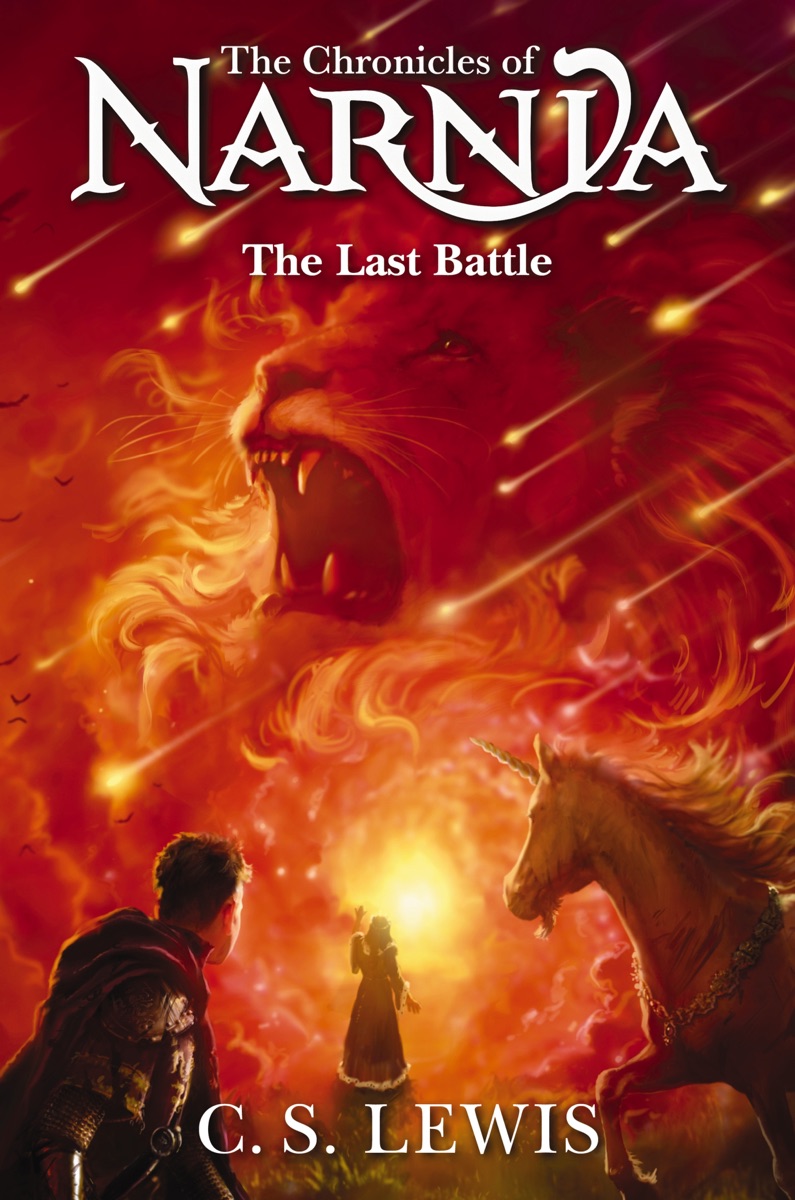
The Last Battle
by C.S. Lewis · The Chronicles of Narnia #7
The final Narnia adventure confronts children with the end of a beloved world—and asks whether destruction can become a doorway to something greater
The story
When a scheming ape dresses a confused donkey in a lion skin and claims to speak for the great Aslan, the last king of Narnia discovers his world is being sold into slavery through deception. With his friends scattered and military hope destroyed, King Tirian must make a final stand against lies, treachery, and a genuine supernatural evil—knowing that this battle cannot be won by swords alone.
Age verdict
Best at 10-13. The theological depth and emotional weight are heavy for younger readers, and the book benefits enormously from investment in the earlier Narnia stories. Mature 9-year-olds in the series can handle it; below that, the apocalyptic themes may disturb rather than inspire.
Our take
A literary-philosophical powerhouse that teachers prize and parents value for deep conversation, but whose apocalyptic weight and limited humor temper kid appeal. The rare book whose teacher scorecard dramatically outpaces its kid scorecard.
What stands out
Each audience's top 3 dimensions. Out of 30 scored per book.
Kids love
- Character voice Strong
Tier 3 — Comparable to The Golem's Eye , triangulated with City Spies — Tirian, Shift, the Dwarfs, and Ginger each have immediate, performable speech patterns. Sits above The Golem's Eye anchor because all four voices are primary to the narrative (not supporting cast); sits below City Spies because there are four core voices rather than five with equal stage time. Shift's 'Not a bit of it!' and Tirian's courtly register are distinctive enough a child performs them.
- Plot unpredictability Strong
Tier 3 — Comparable to Mercy Watson: Something Wonky This Way Comes , triangulated with Artemis Fowl — The central twist (last battle is genuinely lost, not won through rescue) is shocking enough to catch series readers off-guard. The Dwarfs' refusal and creatures' voluntary blindness layer multiple unpredictable consequences. Sits above the Mercy Watson anchor because the surprises are not sensory-trigger mild but philosophically inverted, matching Artemis Fowl's 'multiple genuine reversals' pattern.
Parents love
- Moral reasoning Exceptional
Comparable to Artemis Fowl — Presents moral complexity without providing easy answers. Tirian's dilemma (fight when all is lost), the Dwarfs' cynicism, and Aslan's judgment of the willfully blind all lack clean resolutions. Sits at because each decision point genuinely reflects students' differing worldviews, creating authentic disagreement exactly as the anchor requires.
- Parent-child conversation starter Exceptional
manipulation dynamics, the rationality of cynicism, death and transformation, whether loss can become transcendence. Sits at because parents report these conversations extending well beyond the reading experience, exactly matching the anchor's 'extended conversation' standard.
Teachers love
- Critical thinking development Exceptional
Comparable to A Deadly Education , held at 10 due to original score and architecture — Every chapter requires students to evaluate truth claims, analyze propaganda, assess rationality of cynicism, and distinguish appearance from reality. Sits at 10 because the book rewards only active, questioning engagement; passive reading renders the architecture invisible, making it uniquely demanding of critical thinking as a prerequisite.
- Discussion fuel Exceptional
Comparable to Gathering Blue — Every scene creates authentic disagreement without clean answers. Sits at because students will argue about Dwarfs' rationality, Tirian's choices, and Aslan's justice, bringing their own worldviews to deepen engagement exactly as the anchor requires.
✓ Perfect for
- • Children who love deep stories that stay with them long after the last page
- • Readers who enjoy philosophical questions about truth and belief
- • Families looking for rich conversation material about morality and meaning
- • Students of the Narnia series ready for its emotional and theological culmination
Not ideal for
Sensitive readers who may find the heavy emotional themes and intense imagery frightening or overwhelming, or children seeking lighthearted adventure without deep philosophical content
⚠ Heads up
At a glance
- Pages
- 288
- Chapters
- 17
- Words
- 77k
- Lexile
- 890L
- Difficulty
- Moderate
- POV
- Third Person Omniscient
- Illustration
- Sparse
- Published
- 1956
- Publisher
- Iwanami Shoten
- Illustrator
- Pauline Baynes
- ISBN
- 9784001121070
Mood & style
You'll know it worked when…
A child who finishes and wants to talk about the story—about the choices characters made and what they meant—has connected with the book's core. A child who seems upset or confused may need conversation to process the heavy themes.
If your kid loved "The Last Battle"
Matched across 30 dimensions — interest hooks, character appeal, tone, pacing, emotional core. Not by what other people bought. By what fits the same reader profile.
Messenger
by Lois Lowry
Same genre (fantasy). Both bittersweet in tone

The High King
by Lloyd Alexander
Same genre (fantasy). Both bittersweet in tone

Daughter of the Moon Goddess
by Sue Lynn Tan
Same genre (fantasy). Both bittersweet in tone
The Land of Stories: The Enchantress Returns
by Chris Colfer
Same genre (fantasy). Shared humor: gentle wit
Gregor and the Marks of Secret
by Suzanne Collins
Same genre (fantasy). Same pacing (slow burn to explosive)
Harry Potter and the Half-Blood Prince
by J.K. Rowling
Same genre (fantasy). Same pacing (slow burn to explosive)
Want more picks like this?
Get 5 hand-picked book reviews for your child's age — one email a month.